One of the more common questions that we here in the Milwaukee area, is regarding foam filled windows. Are they actually better? Is the upgrade worth the money? Which type of foam is better, injected or push-in? The answer like many things in life of course is… It depends.
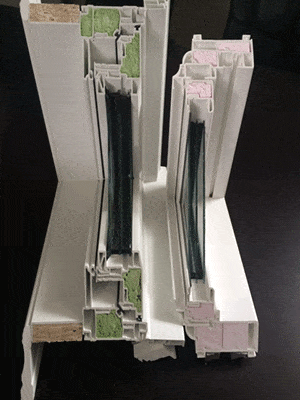
Here are two different types of foam filled windows. Is one better than the other? Check the U-Factor.
Foam Filled Windows have benefits
Foam filled windows will provide some benefits across the board, the debate really comes down to how much of a benefit, and is it worth the added expense. My first recommendation to replacement window shoppers is to check how this option affects the U factor of the window. Some foam filled windows will have a U factor that improves by 2+ points, others will not budge at all. There are a variety of factors for this, most notably in the design of the extrusion(the “inner-framing” of the window). Windows that have many chambers will often see less impact on U factor, because those dead air spaces actually do a decent job of insulating. This is not necessarily reflective of product quality, it is just a different means to an end. That said, the primary benefits to foam filled windows will be superior thermal performance (measured by U factor and condensation resistance), as well as a little bit of extra structural stability. It could be be conceivable to improve sound transmittance as well, however the impact here is probably negligible in most cases.
Types of Foam Filled Windows
The two common methods to foam fill windows are injected foam, where spray foam is actually injected into the extrusion, and push in foam, where expanded polystyrene is cut and pushed in. Despite what sales people may tell you, both are effective methods when executed properly, and each does have its own minor pros and cons. Injected foam is generally higher density, and therefore a better insulator. This advantage is somewhat mitigated however by the fact that these are pretty small spaces, so the actual increase in R factor is minimal. The downside of injected is that spraying foam can produces air pockets and inconsistent fill. Push in foam eliminates that potential issue, however this type of foam must be cut to exacting tolerances where it provides a tight fit in the chamber to be effective. The manufacturers that do this right, have CNC machines that cut the foam precisely to fit.
Bottom Line
Ultimately, the option for foam filled windows is better, however the value of it depends on the price vs performance increase. This is generally a pretty inexpensive option, so it does make sense in many cases. The one thing to keep in mind, is that when comparing two different products, the type or even presence of foam filling does not necessarily make that product better than the other. A precisely designed and manufactured unit will be the better option, with or without foam.
Brandon Erdmann is the owner of HomeSealed Exteriors in Milwaukee, WI. He’s a window installation expert, a supporter of this site and an all around great guy. If you’re in the Milwaukee area and you’re thinking about new windows you should give Brandon a ring. You’ll be glad you did.
We get asked about the differences between bow vs bay windows all the time. We finally decided it was time to whip up a post with the correct answer for all to see.
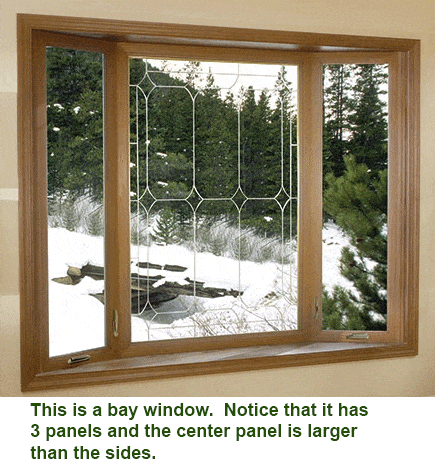
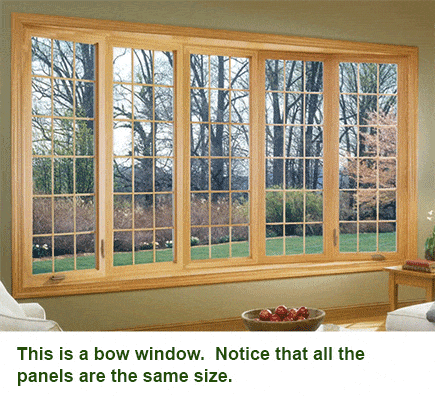
To put it simply the difference is in the layout of the windows. Both bow and bay windows stick out from the house, but they have a different look. Bow windows are made up of equal sized lites or panels while bay windows have a center section that is larger than the sides.
We may need a picture for this one. First we’ll start with a bay window.
Ok, so that’s a bay window. 3 panels, and the center is larger than the sides.
Now, here’s a bow window: See the difference? The bow has several panels and they’re all the same size. A bow window can have 3, 4, 5, 6 or more panels, but they’re always the same size.
Is a bow window better than a bay window?
Nope, it is really just a style difference. Do you prefer the look of the larger picture window in the center or a bay window or would you rather have several symmetrical panels? One is not better than the other, they’re just different.
What is the price difference between a bow and a bay window?
The difference in cost is typically pretty small. Many manufacturers will charge more for a bigger window, but the difference between a bow and a bay is typically not a huge driver of the cost. A bow window with many panels (called lites) will typically cost more than a bay window with only 3 lites.
A cost difference of a few hundred dollars wouldn’t be unusual, but you shouldn’t see much more difference than that.
As you’re shopping for new windows be sure to check out our detailed window reviews here. If you’re looking for anything that you can’t find be sure to post a comment or send us an email. We read every single one and we’ll do our best to respond.
Here’s a little bit of terminology that is often misunderstood. What are the differences between single hung vs double hung windows? Here we’ll take a look at the basic definition and we’ll look at some of the other advantages and disadvantages including the cost, the operation, the screens, how they function and the typical price.
First things first! The basic definition:
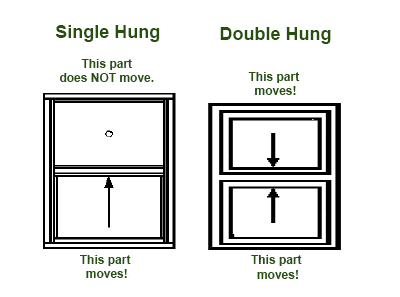
Both single hung and double hung windows open up and down. The difference is that in a single hung window the bottom sash opens up and down, but the top does not move.
In a double hung window the bottom sash slides up and down AND the top sash also opens and closes.
Perhaps this picture will help:
Here is the difference between a single hung and a double hung window.
Well, that’s really up to you. One important thing to keep in mind is that a single hung window does not allow the top sash to tilt in for easy cleaning. That means the bottom will tilt in, but the top will not. Is that a big deal? Only you can decide.
Beyond that many people don’t open the top very often so the difference is not important to them. We open the top quite a bit in my house as the window dog is a redbone coonhound from the hills of West Virginia and he would go straight through a screen if he saw a varmint in the yard. For us it is very important that the top opens, but you may have different priorities.
What is the price difference between single hung vs double hung windows?
This is a question we get asked a lot. The difference typically isn’t huge, but it can add up. The two windows are essentially the same with the single hung having less hardware. The cost difference between the two will depend on the manufacturer, but it wouldn’t be uncommon to see a price difference of $20-$40 per window.
If you have 20 windows in your house that amount can add up. We’ll often suggest switching to single hung windows as a way to save a few bucks, but it really just depends on how you plan on using them.
We hope that helps, for more detailed info on the greatest replacement windows check out these reviews. If there is anything you’re looking for that you can’t find just post a comment or send us an email. We read every single one and we do our best to respond!
Folks ask us all the time if they should get replacement windows or new construction windows. Are the windows the builder uses when they build a new home really any better or worse than the replacement windows that are sold by companies all over town?
We’re going to get to the bottom of this great debate right here. Get ready!
Before you can understand which option is better for you, you’ll need to understand what the terms mean. Basically a new construction or new home window is designed to be installed before the siding or brick is installed on the exterior of the home. A replacement window is designed to be installed after the siding or brick is already on the home.
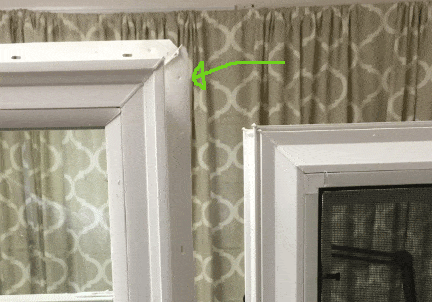
Take a look at this picture. Here you can see two Pella windows that I bought from Lowes. The two models are very similar, but one has a fin that goes around the perimeter. This is called a nail fin and it is the only real difference between replacement vs new construction windows.
This nail fin around the edge of the window is the only difference between replacement vs new construction windows.
That’s the only difference. Now, some people of varying degrees of honesty may tell you there are other differences beyond the nail fin (also called a nail flange). Let’s take a look at what someone might say.
New constriction windows are builder grade windows. They’re cheap and flimsy.
Manufacturers build new construction windows with builders in mind. Believe it or not they’re more focused on the builder who buys thousands of windows than you, the guy looking to install 15 new windows in your home.
They know that builders want windows fast and cheap so that’s what they make. Builders know that when you’re buying a new home you’re looking at the fancy tub and the shiny kitchen. The windows are often an afterthought so they don’t spend any more money than they need to.
Here’s one way to think about it. When you’re buying a new home you’re buying a whole lot of things all at once. You’re less focused on each individual thing. When you’re buying replacement windows you’r just buying windows. You’re focused on the windows and you’re trying to get the best products you can.
Manufacturers of both new construction and replacement windows know this very well and they prioritize quality and costs based on the typical customer for each product.
If you’re buying new construction windows and you’re looking for quality be careful. It’s easy to go wrong here.
New construction windows will give me more light than replacement windows.
This may be true, but it may not. You’ll need to have a good idea of how the windows will actually go in before you can make that determination. Remember, the only real difference is the nail flange. The window itself is the same.
Often times replacement windows are installed inside the existing wood window frame. This is called a pocket installation because the window is placed in a pocket in the old frame.
There is nothing wrong with this installation method. In fact all new vinyl windows have a 3.25″ jamb depth because they’re designed to be installed in a wood frame.
Could you get more glass area by removing the existing wood frame? Maybe, but maybe not. If you remove the wood frame a new wood frame would typically need to be installed. Sometimes this comes with the windows, sometimes the installer will build it on site, but it is typically part of the installation. Is the new wood frame any thicker or thinner than the old wood frame you removed?
I have no idea, it depends on your house and you’re installer, but the difference is probably not dramatic. This is often used as a sales tactic, but it typically doesn’t make any noticeable difference.
New construction windows form a better seal than replacement windows.
I would expect this idea is spread by folks who are more familiar with new construction window installations. When installing a new construction window it’s easy to see how it’s sealed. Typically the nail flange is fastened to the sheathing then there is a moisture barrier (like a house wrap) and flashing tape applied in a specific manor around the window. When done properly it looks solid and it’s easy to see that it’s done.
In a replacement window installation it’s harder to see because you’re relying on the seal of the existing frame behind the siding. There are literally millions of replacement windows installed each and every year with no epidemic of leaks so it’s safe to assume that if they’re installed properly there is no greater risk of a leak from a new construction or new home windows compared to replacement windows.
So, which one is better?
Like most things in the window business there isn’t necessarily an easy answer. In general new construction windows are cheaper and of lower quality than replacement windows, but there are nice new construction and cheap replacement windows. The best strategy we can suggest is to find some local experts to take a look at your home and make a few suggestions.
We know the window business can be difficult to navigate and we applaud you for taking the time to do your research before making a decision. We would suggest doing the same thing when calling local window companies. We’ve done some of the work for you. For starters you can find our list of the best local window companies right here.
If you’re looking into replacement windows in 2025, there’s a good chance you’ve come across Preservation Windows. They’re marketed as premium, energy-efficient, and custom-built — but are they really worth the higher price tag?
In this detailed review, we’ll cover everything you need to know before signing a contract — including prices, warranty details, energy efficiency, common complaints, and how Preservation stacks up to ProVia, Alside, and Simonton.
Review Snapshot
Last Updated: November 15, 2025
Manufacturer
Preservation
Window Type
Vinyl Frames
Price Range
$$$ (Expensive)
Warranty
Lifetime Residential / Transferable
Reviewer
Dan Schweihs – 20+ years in window replacement
★★★★★
★★★★★
4.2 / 5 Overall
Pros
Backed by a large manufacturer
Good quality products
High-end components and efficiency
Cons
Often very expensive
Commonly sold on commission
Not great value
Note: You can now get an itemized quote for quote for Preservation windows and doors with no pushy salesman in your house. Whether you order these windows or not this will be helpful information because it is real and concrete and there is no sales visit required.
🏆 Quick Verdict
Preservation Windows are a premium vinyl window line owned by Associated Materials (AMI) — the same company behind Alside and Gentek. They’re sold as a higher-end product through exclusive dealers, focusing on long-term durability, energy efficiency, and custom aesthetic options.
They perform well, look great, and come from a reputable manufacturer — but as with most premium vinyl products, value depends heavily on the dealer, installation quality, and price transparency.
I’ve personally known several Preservation window dealers over the years. In my experience these windows are sold at very high prices by commission based salespeople. Their quality is good, but the prices are high. The features are good, but you can get the same options from other companies too. When you look at what you pay vs what you get these windows are not always the best value.
Category
Score
Notes
Quality
88
Premium-grade vinyl; solid frame construction
Energy Efficiency
92
Excellent when upgraded with ClimaTech® glass
Options & Aesthetics
86
Great finishes and decorative styles
Warranty
90
Strong limited lifetime coverage
Price
78
Higher than average for vinyl
Overall
87 (B+)
High quality, but shop carefully for pricing
Bottom Line: Preservation offers high-end vinyl performance and great looks for homeowners who plan to stay in their home long-term. You’ll pay more than you would for mid-tier vinyl like Alside Mezzo or Simonton Reflections 5500, but the step-up in design and efficiency is noticeable.
Preservation window salespeople often make high commissions which inflates the retail prices without adding much value at all.
To find a better value look for the Gentek Signature Elite product line. The Signature Elite model is made by the same parent company, uses the same type of upgraded hardware and components and is now offered by national dealers using an online sales model at better prices.
Who Makes Preservation Windows?
Preservation is manufactured by Associated Materials (AMI), a long-established U.S. building products company that also owns Alside and Gentek. While Alside focuses on mainstream affordability and Gentek caters to higher end customers looking for a better value, Preservation serves as AMI’s premium vinyl window brand — often sold through select authorized dealers which can cause prices to be high relative to the value they provide.
That matters because AMI’s size and stability mean stronger warranty support, consistent manufacturing, and access to replacement parts for decades to come.
Preservation windows are built from premium, multi-chambered vinyl engineered for both strength and insulation. You’ll notice cleaner welds and smoother operation compared to more basic vinyl windows.
Key design features include:
Fusion-welded frames and sashes for rigidity
Reinforced meeting rails to prevent warping
Sloped sill design for drainage and air control
ClimaTech® insulated glass systems (Low-E + argon)
Optional decorative grids, woodgrain interiors, and hardware upgrades
Overall, the build quality is excellent for a vinyl window. If you’re comparing them side-by-side with Alside or Simonton, Preservation feels heavier and more solid.
Energy Efficiency & 2025 Federal Tax Credits
Preservation windows are ENERGY STAR® 7.0 certified when properly configured and can qualify for the 2025 Federal Energy Efficient Home Improvement Credit (25C) — worth up to $600 per household per year.
Their ClimaTech® glass options use combinations of Low-E coatings, argon gas fills, and warm-edge spacers to minimize thermal loss.
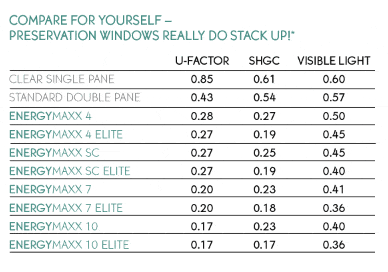
If you live in a cold climate, you’ll want a U-factor under 0.27. In hot regions, look for a Solar Heat Gain Coefficient (SHGC) below 0.30.
Preservation windows are priced above mid-range vinyl lines due to their dealer-exclusive nature and higher-end features. Expect quotes to vary significantly based on dealer markup and upgrades.
Average Installed Prices by Style
Style
Average Installed Price
Notes
Double Hung
$950 – $1,500
Most popular style
Slider
$900 – $1,400
Wide openings, good ventilation
Casement / Awning
$1,100 – $1,800
Great for energy efficiency
Bay / Bow
$3,500 – $6,500
Structural framing adds cost
Picture / Fixed
$700 – $1,200
Best price per square foot
👉 Remember you can get a real quote by email from Window Universe for Preservation Reserve windows. Whether you buy from them or not this will be helpful information. See how your existing quote compares or make sure you’re getting a fair deal by getting a Preservation window quote by email.
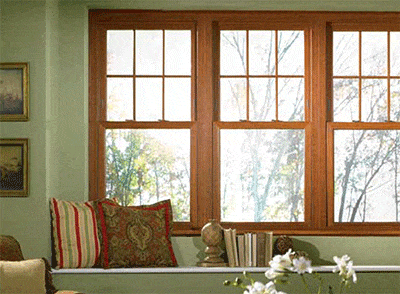
Here’s a glamor shot of some Preservation windows with an interior woodgrain finish.
FAQs: Preservation Windows 2025
Are Preservation windows good? Yes. They’re high-quality vinyl windows offering excellent insulation, appearance, and durability — backed by a strong warranty.
Who makes Preservation windows? Preservation is owned by Associated Materials (AMI), the same parent company as Alside and Gentek.
How much do Preservation windows cost? In 2025, most Preservation windows cost between $950 and $1,500 installed per window, depending on style and region.
Do they qualify for the 2025 federal tax credit? Yes, when ordered with ENERGY STAR®-qualified ClimaTech® glass packages.
What’s the warranty like? Preservation offers a limited lifetime warranty that covers vinyl, glass, and hardware. Labor depends on your installer.
Preservation vs. ProVia — which is better? ProVia Endure has slightly better efficiency and color customization. Preservation offers comparable quality and is often easier to get through local dealers.
Find the Best Window Companies Nationwide
If you’re considering Preservation windows — or just want honest, pressure-free pricing — the best move is to find a reputable, transparent installer.
We maintain a list of recommended window companies all over the U.S. — companies that treat customers fairly and explain pricing upfront.
Our Commitment to Accuracy
We’ve been writing about replacement windows for over a decade. Our goal is simple: to give homeowners clear, honest, and accurate information — without the sales pressure.
If you believe anything in this post is incorrect, please contact us with supporting details. We’ll verify and update the post right away.